
Guide
Packaging Temperature: Map the Journey Before Chasing Foam
Map product temperature from tank to filler, diagnose foam without guesswork, and restart packaging with steadier conditions.
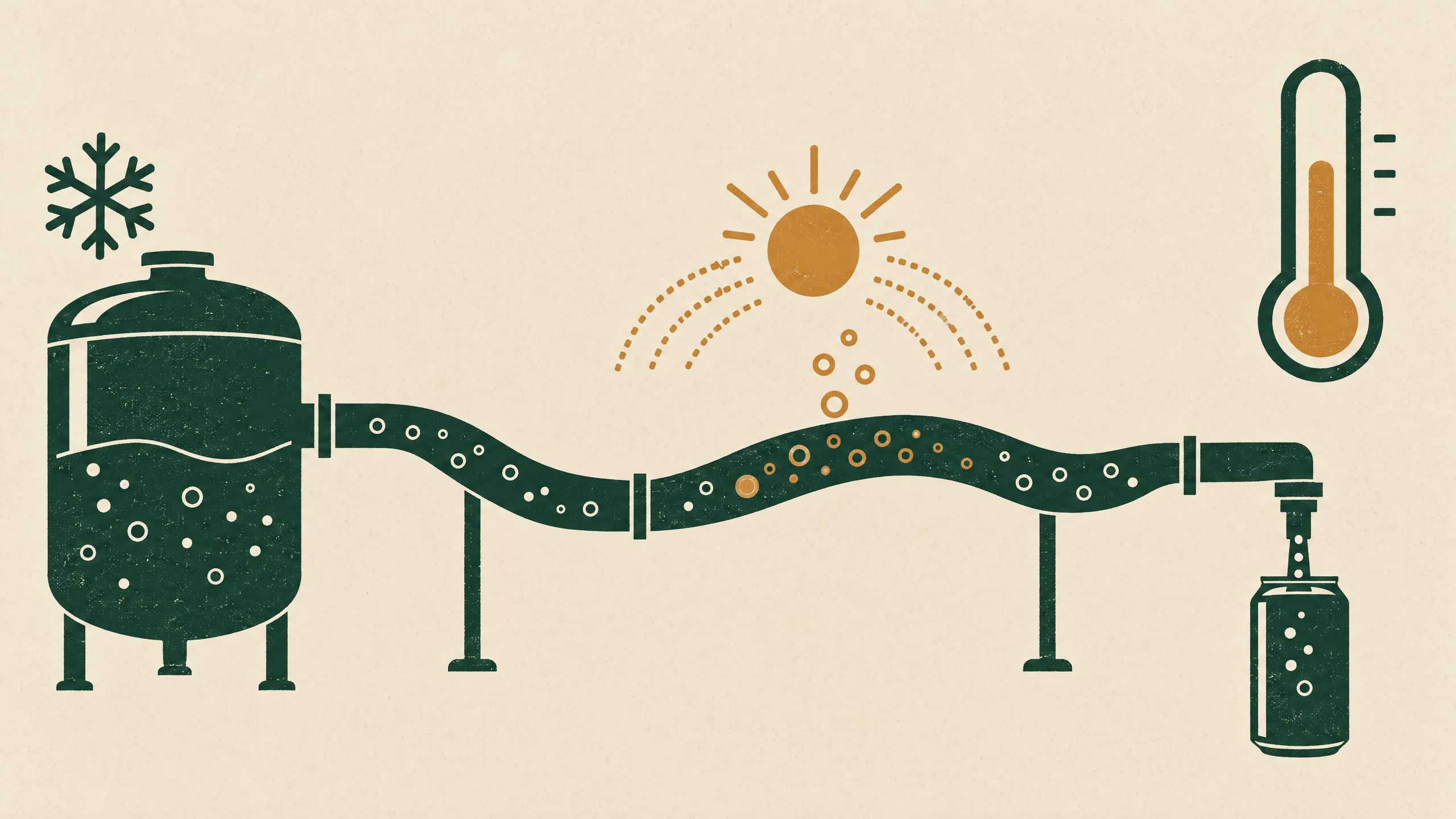
A batch can leave the tank calm and still become lively at the filler. Product may pick up heat in a hose, manifold, staging vessel, filler bowl, or while it waits. When that happens, a carbonation problem may really be a temperature-path problem. Start with one useful question: what temperature is the liquid at each point in its journey?
Carbon dioxide equilibrium depends on temperature and CO₂ partial pressure. Colder liquid supports more dissolved CO₂ at a given pressure; if a carbonated product warms, its equilibrium changes and gas is more likely to come out of solution. Reference data for the CO₂–water system show why both temperature and pressure belong in that relationship.[1] Treat this as a process principle, not a table to apply without validating your own beverage.
Follow the product, not the display
A controller can be doing exactly what it was asked to do while the product downstream sees a different condition. Vessel temperature is not automatically filler temperature, and a pressure display is not a direct measurement of dissolved CO₂. Use those readings as process information, then verify the finished product with a suitable calibrated method and sampling practice.
Make a simple temperature map for a normal run. Record actual product temperature, time, and line state at repeatable points:
- tank before transfer;
- first product leaving the transfer path;
- inlet to the filler or packaging vessel;
- first stable packages; and
- the same points after a meaningful pause or restart.
Note whether the line was conditioned, whether product was moving, wait time, vessel level, and the location of each pressure reading. Several runs build a baseline your crew can use when a problem returns. This works across beer, cider, kombucha, seltzer, and other small-batch beverages, but does not replace product-specific quality checks.
Pauses are a second start-up
During a pause, product can stand in warmer hardware while the tank stays cold. Treat the restart as a small commissioning check. Confirm that the transfer path and packaging equipment are back at their intended operating condition under your site SOPs. Then capture the first product temperature at the filler and compare it with the pre-pause record.
If the first minutes show more breakout or unstable fills, let the map guide the investigation. Heat gained during the hold may be the cause, rather than a reason to change the batch’s carbonation target. Do not chase a fresh foam event with a pressure adjustment. Pressure-rated equipment, relief protection, ventilation and CO₂ monitoring, and equipment instructions set the boundaries for any pressure work.
Separate a cooling fault from a pressure fault
Temperature and pressure faults can produce similar packaging symptoms, but they leave different trails.
A cooling or temperature-path fault often appears as a rising product temperature between tank and filler, or as a difference between a steady run and the first product after a delay. Check line conditioning, insulation, warm surroundings, fittings, and idle time. Confirm that the temperature sensor represents the liquid you are trying to control, rather than only the jacket, room, or a remote point.
A pressure or flow-path fault is more plausible when the temperature map is steady but behaviour changes with tank level, transfer flow, restriction, or pressure-reading location. Liquid pressure increases with depth, so a lower outlet has a hydrostatic contribution that headspace pressure alone does not show.[2] As the level changes, that contribution changes. Record where pressure is measured; a stable headspace reading does not make every point downstream stable.
Keep oxygen control in a third lane. Foam is not proof that dissolved oxygen rose, and reducing foam is not a dissolved-oxygen measurement. Package preparation, leaks, line and filler design, and operation all matter. When oxygen is a concern, verify it with an appropriate measured quality check rather than using foam as a proxy. Brewing quality practice recognizes optical, polarographic, and galvanic dissolved-oxygen sensor technologies.[3]
Build line readiness around the actual batch
There is no universal packaging temperature target for every beverage, package, filler, and process. Define a validated operating window for your product, then make the line ready to hold it. Before packaging, confirm measured product temperature at the handoff point, the readiness of the transfer path, the intended measurement locations, and the response to a planned brief stop. Keep sanitation, maintenance, and pressure-equipment checks within approved SOPs.
The practical takeaway is steady work, not a magic number: follow the product from tank to package, record what changes during a pause, and diagnose temperature, pressure, and oxygen as separate questions. That gives a small team a repeatable way to find where the line changed.