
Guide
Natural vs. Forced Carbonation for Cider and Kombucha
Compare natural and forced carbonation for cider and kombucha, with practical guidance on fermentation, control, packaging, and safety.
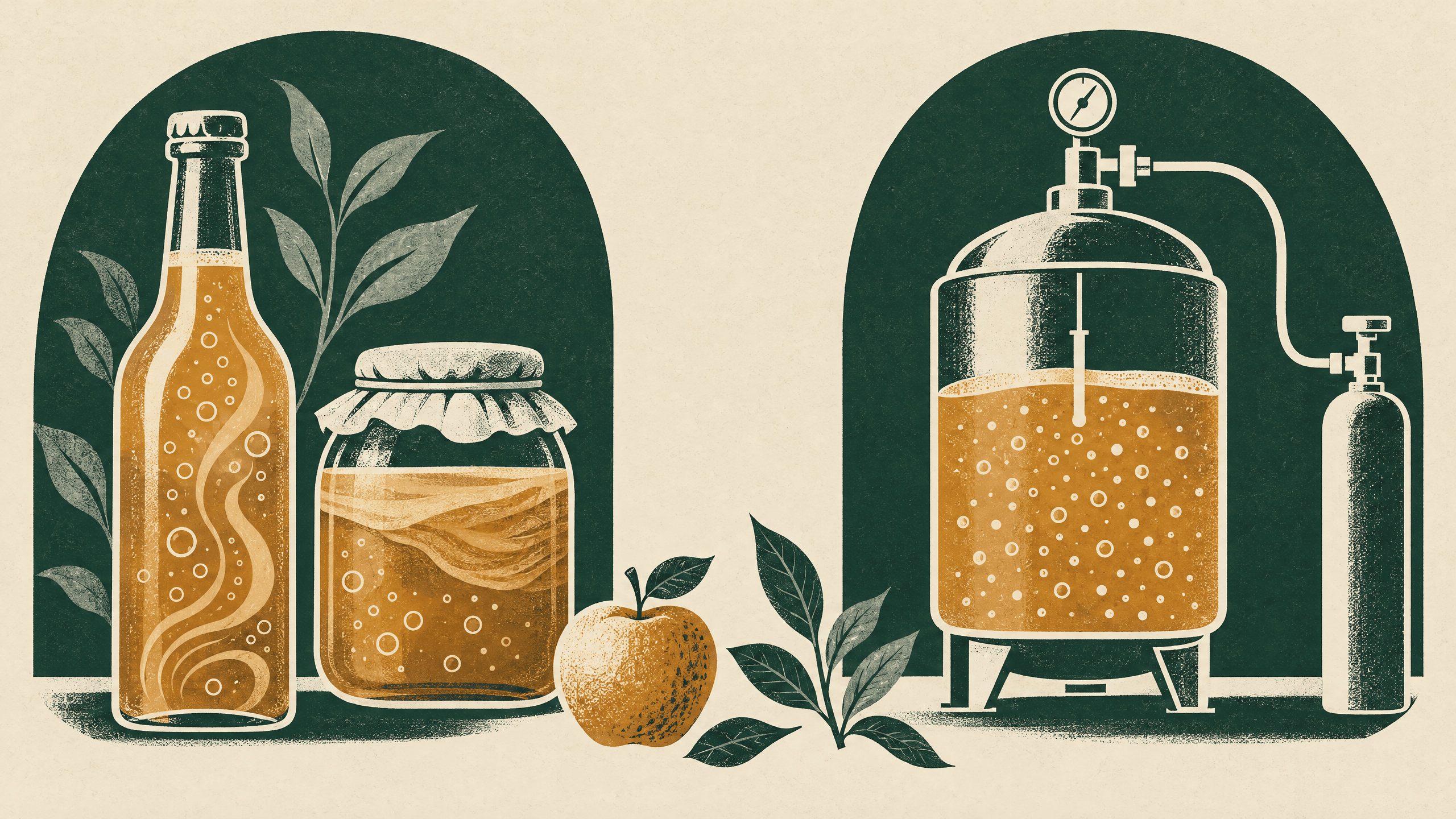
Natural and forced carbonation can both make a lively cider or kombucha. The useful difference is not which method is more authentic. It is where the carbon dioxide comes from, and how much of the final pour remains a living fermentation process.
Natural carbonation is a live finish
With natural carbonation, yeast turns fermentable material into carbon dioxide after the product is in a sealed environment. That conditioning may happen in the individual package or in a sealed, pressure-rated vessel before packaging. In either case, the fermentation creates the gas that becomes the fizz. Bottle-conditioning guidance identifies viable yeast, fermentable material, time, and temperature as the interlocking parts of that process.[1]
That makes natural carbonation more than a packaging choice. The maker is managing a biological finish. Yeast health, the amount and fermentability of material still available, sanitation, package or vessel integrity, and the actual time course all matter. A batch can develop the character a maker wants, but the outcome should be checked rather than assumed from a planned process alone.
For cider, this can be a deliberate part of a bottle-conditioned style or a bulk-conditioning workflow. For kombucha, it may also be part of a live-product identity. Neither use case makes natural carbonation inherently better; it simply puts fermentation activity closer to the finished product.
Forced carbonation separates the gas from the ferment
Forced carbonation adds external carbon dioxide to a finished beverage under managed process conditions. It lets a maker establish carbonation without asking a final fermentation to generate the gas. The same basic equilibrium applies across beverages: the amount of dissolved CO₂ is related to its partial pressure above the liquid, while temperature and pressure affect that equilibrium. Colder liquid can hold more dissolved CO₂ at the same carbon-dioxide partial pressure; a warmer liquid needs different conditions to hold the same equilibrium carbonation.[2]
That is useful control, not a shortcut around verification. Tank pressure and product temperature describe process conditions; they are not a direct measurement of dissolved CO₂ in the beverage. Use a suitable calibrated method and representative sampling to verify the finished result. Contact time, gas–liquid contact, mixing, stone condition, and installation can affect how quickly a batch approaches its target, even when the equilibrium conditions look right.
Most importantly, adding CO₂ does not stabilize a live beverage. Force carbonation can change the gas in solution, but it does not by itself stop viable yeast, remove residual fermentables, or prevent further fermentation. That distinction is especially important for kombucha and for cider that has not reached a verified stable state.
Choose the cider process around the finish you want
A naturally carbonated cider can suit a maker who wants fermentation to carry through to the final texture and presentation. It asks for confidence in the conditioning process and in the package or vessel selected to contain it. A forced-carbonated cider can suit a chilled tank-to-package workflow where the maker wants the gas addition handled separately from the finishing ferment.
Either route needs its own release checks. Consider the product’s fermentation status, intended sweetness, carbonation verification, closure or vessel suitability, and how the batch will be stored and handled after packaging. Treat those as separate decisions. A clean-looking pour or a satisfying opening sound cannot, on its own, prove the finished carbonation level or fermentation status.
For kombucha, biology remains central
Kombucha deserves an extra pause because its culture and remaining fermentables can continue changing the product in package. The Pennsylvania Department of Agriculture notes that yeast can continue to produce alcohol and carbon dioxide in packaged, unpasteurized kombucha; carbon-dioxide buildup can create pressure hazards if it exceeds what the container can hold.[3] The U.S. Alcohol and Tobacco Tax and Trade Bureau likewise warns that alcohol can increase after bottling because of continued fermentation.[4]
Those points do not rule out either carbonation path. They mean the carbonation decision must sit inside a broader control plan for the particular product. Natural carbonation deliberately relies on that activity. Forced carbonation may provide a separate, controlled gas addition, but it does not neutralize the culture or erase the need to monitor the product through its intended shelf life. Establish controls, testing, and handling practices with the requirements that apply where you make and sell the beverage.
A practical choice check
Before choosing a path for a cider or kombucha batch, ask:
- Do you want fermentation to generate the final CO₂, or do you want to add CO₂ after the fermentation decision is complete?
- Where will carbonation develop: a pressure-rated conditioning vessel, the final package, or a finished tank before packaging?
- What evidence will confirm both dissolved CO₂ and fermentation status, rather than relying on a gauge, appearance, or sound?
- Are the vessel, package, relief protection, handling procedures, ventilation, and CO₂ monitoring appropriate for the process and site?
Follow equipment manufacturers’ instructions and your own safety procedures. Pressure-rated equipment and relief protection are not optional details, and cleaning chemicals should be handled only under their approved procedures.
Natural carbonation gives fermentation a role in the final package or vessel. Forced carbonation brings CO₂ in as a separate process step. Both can support a bright, well-made pour. The right choice is the one that fits the desired product and gives the maker a clear way to verify what is actually in the glass.