
Guide
Kombucha Carbonation Without the Guesswork: Separate Fizz From Fermentation
Learn how tank-based forced carbonation separates a controlled fizz step from ongoing kombucha fermentation, alcohol change, and package-pressure risk.
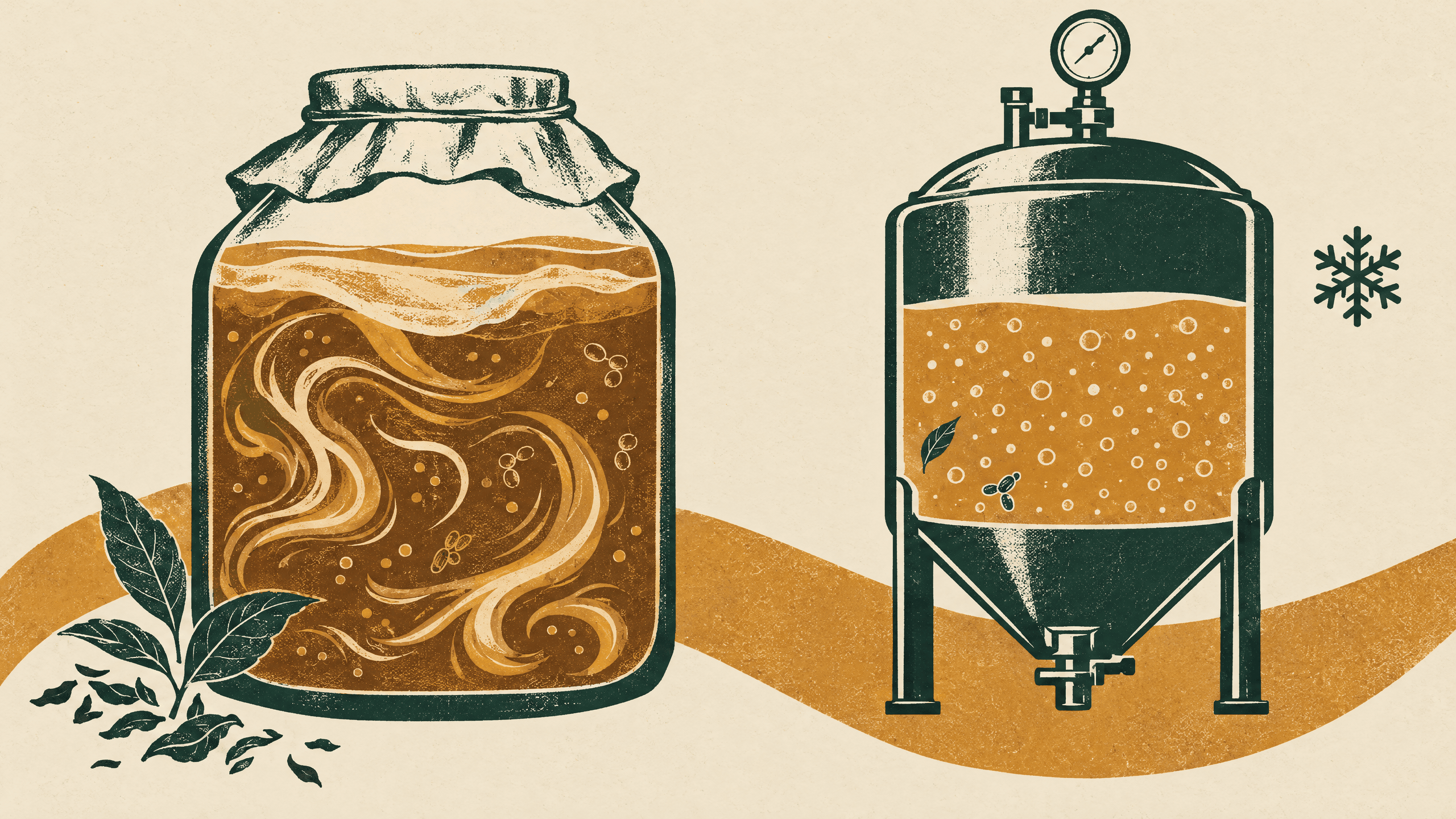
Kombucha makers are often managing two related processes that should not be mistaken for the same job. Fermentation shapes the drink through a living culture. Carbonation is the dissolved CO₂ that gives the pour its lift. When those jobs blur together, inconsistent fizz can hide a much bigger question: what is the packaged kombucha still doing?
A naturally carbonated kombucha can be a fine choice. Secondary fermentation in a sealed, pressure-rated vessel or package creates both CO₂ and ethanol, so it can bring its own character as well as its own variables. Forced carbonation takes a different path: CO₂ is introduced to a pressure-rated vessel from an external gas supply. Neither approach is automatically better. The useful decision is whether you want the carbonation step to be independent of continuing fermentation.[1]
Give fermentation and fizz different jobs
With force carbonated kombucha, the maker can decide on the fermentation profile, then carbonate the liquid in a chilled tank before packaging. Temperature and CO₂ pressure are the main conditions governing equilibrium carbonation; at the same CO₂ pressure, a colder liquid can hold more dissolved gas. Sugar and ethanol also affect the exact relationship, which is why a water-only chart is only a starting point for kombucha.[1]
That is valuable control, not a shortcut. A tank gauge reports process pressure, not a direct measurement of dissolved CO₂. Product temperature and pressure can be used to establish and hold carbonation conditions, but a suitable calibrated measurement method and representative sampling are still how a maker verifies the finished drink. Dissolution also takes time and depends on gas-liquid contact, stone condition, mixing, and installation.
This distinction helps diagnose kombucha carbonation problems. If the tank condition is consistent but the finished package changes later, the cause may be biological activity, formulation, closure performance, or handling after packaging, not simply a missing dose of fizz.
Cold handling is control, not proof of stability
Refrigeration matters for live kombucha, but it does not turn a living product into a verified stable one. New York’s food-safety guidance notes that unpasteurized kombucha contains live cultures and can continue fermenting and raise alcohol over time, especially when handled without refrigeration. British Columbia guidance likewise identifies live cultures, residual sugar, excess alcohol, and gas formation as linked packaged-product concerns.[2][3]
The operational point is simple: chilling and force carbonation do not, by themselves, demonstrate that fermentation, alcohol change, or package-pressure growth have stopped. Fruit, juice, or other flavour additions can change the fermentation picture when they contribute fermentable material. Treat every formula and package format as its own process question.
That also makes shelf life a production task rather than a date on a label. Build a verification plan around your intended storage and distribution conditions. British Columbia’s guidance calls for shelf-life testing that predicts alcohol evolution and for actual end-of-life measurements; that is a sensible discipline even where a different regulator has authority.[2]
Requirements for alcohol, refrigeration statements, ingredients, and other label details are jurisdiction- and product-specific. New York, for example, has rules for unpasteurized kombucha sold there, but they are not a universal label template. Confirm the applicable requirements with the relevant regulator and process authority for the markets you serve.[3]
A practical verification loop before packaging
Use a short, repeatable loop to keep the biology and the bubbles visible:
- Record the liquid you are packaging. Track formulation, fermentation status, product temperature, and tank conditions for each batch.
- Verify carbonation independently. Use a calibrated method and a representative sample; do not treat a controller target or a pressure reading as the dissolved-CO₂ result.
- Test through the intended shelf life. Monitor the attributes that matter to your product, including alcohol and package condition, at packaging and at planned end-of-life points.
- Protect the package. Use equipment and containers rated for the service, maintain closures and filling equipment, and follow manufacturer-specific pressure, relief, sanitation, ventilation, and CO₂-monitoring procedures.
- Review the trend, not one number. A result that drifts across storage is a prompt to revisit formulation, process controls, package choice, or the validation plan.
For a producer already using a chilled, pressure-rated carbonation tank, FizzWizz is one way to automate the carbonation step. The manufacturer says it reads product temperature and tank pressure, calculates a finish pressure for the selected carbonation level, adds CO₂ through a carbonation stone, and holds target tank pressure until packaging. Use that as control of tank conditions, not as proof of dissolved CO₂, microbiological stability, alcohol compliance, or package safety.[4]
Make the final check as carefully as the final pour
The steadier kombucha process is not the one with the most pressure. It is the one that gives fermentation and fizz separate control plans, measures the finished product, and follows it through real shelf life. If tank carbonation is under consideration, map those sampling and release checks before changing the equipment. That is how a lively pour stays a considered one.