
Guide
Carbonation Top-Ups: Bring Residual CO₂ to Target with Measured Adjustments
Learn when a carbonation top-up makes sense, how to measure residual dissolved CO₂, and how to make a controlled adjustment without guessing.
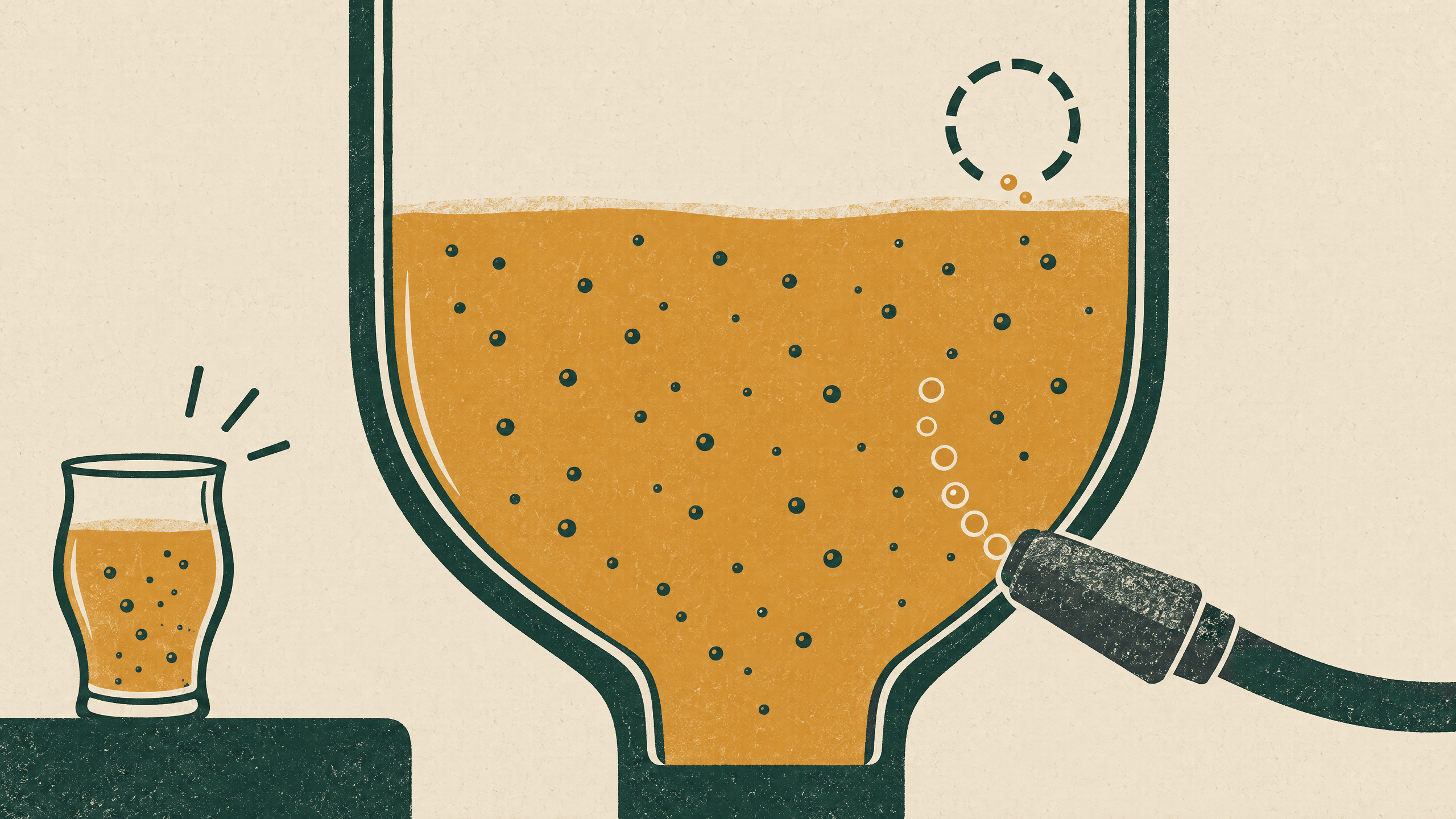
A tank does not always begin its final carbonation stage at zero. Product may arrive with residual dissolved CO₂ after fermentation, transfer, conditioning or an earlier process step. When that starting point is known, a carbonation top-up can be a sensible way to close a modest gap to the batch target rather than treating the tank as completely flat.
The useful word is known. A top-up is a measured, incremental adjustment of residual carbonation. It is not a guess based on whether the pour looks quiet or feels a little soft. Foam, texture and the sound of a pour are worthwhile sensory observations, but they do not establish a dissolved-CO₂ value on their own.
Start with the batch you actually have
First, decide whether the batch is a good candidate for adjustment. You need a defined target for that product and a representative sample that can be tested by a method suited to your beverage and site. The American Society of Brewing Chemists lists methods for dissolved CO₂ in tanks, bottles and cans, including procedures for residual CO₂ in beer samples. That is a useful reminder that residual carbonation is a measurable starting condition, not just a hunch.[1]
A tank gauge is still valuable process information, but it is not a direct measurement of dissolved CO₂. Pressure has meaning only alongside product temperature, gas composition and the state of equilibrium. Measurement methods themselves account for those relationships: MEBAK’s volumetric-expansion method records equilibrium pressure and temperature, and notes that other dissolved gases can affect a result unless the method corrects for them.[2]
Take the sample, use your validated handling and testing procedure, and record the result with the batch, temperature and sampling point. Keep the target and the actual result in the same units. That gives the team a defensible gap to close and a clean record for the next batch.
Use temperature as context, not a shortcut
At a given CO₂ partial pressure, colder liquid can hold more dissolved CO₂ than warmer liquid; reference data for CO₂ in water show solubility changing with both temperature and pressure.[3] Real beverages add their own variables, including alcohol, extract, sugar and acids. The practical lesson is simple: compare and adjust a batch under controlled, documented conditions rather than carrying a pressure reading from one temperature to another as if it were a fixed carbonation value.
Temperature and pressure describe the conditions you are holding. They do not prove how much CO₂ is dissolved in the product. They also do not tell you how quickly the liquid will take up gas. Gas-liquid contact, stone condition, mixing, installation and time all matter. Let a stable condition and a verified measurement, not urgency, decide the next move.
A careful top-up sequence
A good top-up is deliberately uneventful. Build it into the same production discipline you use for any controlled tank adjustment.
- Confirm the batch is ready. Resolve active fermentation, an uncertain transfer history, an unexplained pressure change or a suspected leak before using carbonation to paper over the symptom.
- Measure residual dissolved CO₂. Use a representative, properly handled sample and a calibrated method appropriate to the beverage.
- Set the incremental objective. Work from the measured gap to the product specification, not from a generic tank-pressure setting.
- Adjust under your approved SOP. Use pressure-rated equipment, relief protection, trained handling and the site’s CO₂ ventilation and monitoring practices.
- Allow conditions to settle, then verify again. Re-sample and re-measure before release or packaging. If the result is not where it should be, investigate the process conditions before adding more gas.
This sequence protects the main advantage of a top-up: it preserves a usable starting point while keeping the finish decision tied to evidence. It can also reveal whether the issue is truly residual carbonation or something upstream, such as an inconsistent sampling routine, temperature shift, gas-contact problem or packaging constraint.
When not to use a top-up
Do not make a top-up the default response to every low reading. If the starting value is unreliable, the product is still changing, or the target is unclear, stop and restore the measurement plan first. A major or unexplained deviation deserves diagnosis, not repeated increments. The same is true when pressure-rated equipment, safeguards or trained supervision are not in place.
For beer, cider, kombucha, seltzer and other small-batch pours, the release check matters as much as the adjustment. The final decision belongs to the verified product sample and your product specification, not to a controller display or an attractive-looking pour.
Where FizzWizz can fit
Where FizzWizz is part of the cellar, its manufacturer describes using product temperature and tank pressure to calculate and hold carbonation process conditions, with CO₂ added through a carbonation stone. That can support a controlled adjustment, but it does not replace a suitable dissolved-CO₂ measurement or release check.[4]
The practical takeaway is modest: measure what is already in the tank, make only the adjustment the batch needs, then verify the finished product. That is how a carbonation top-up becomes a repeatable piece of craft rather than a last-minute rescue.