
Guide
Carbonation Changes During Packaging: What Happens as the Tank Empties
Learn why growing headspace and falling hydrostatic head can change packaging conditions, and how to diagnose early-to-late run drift.
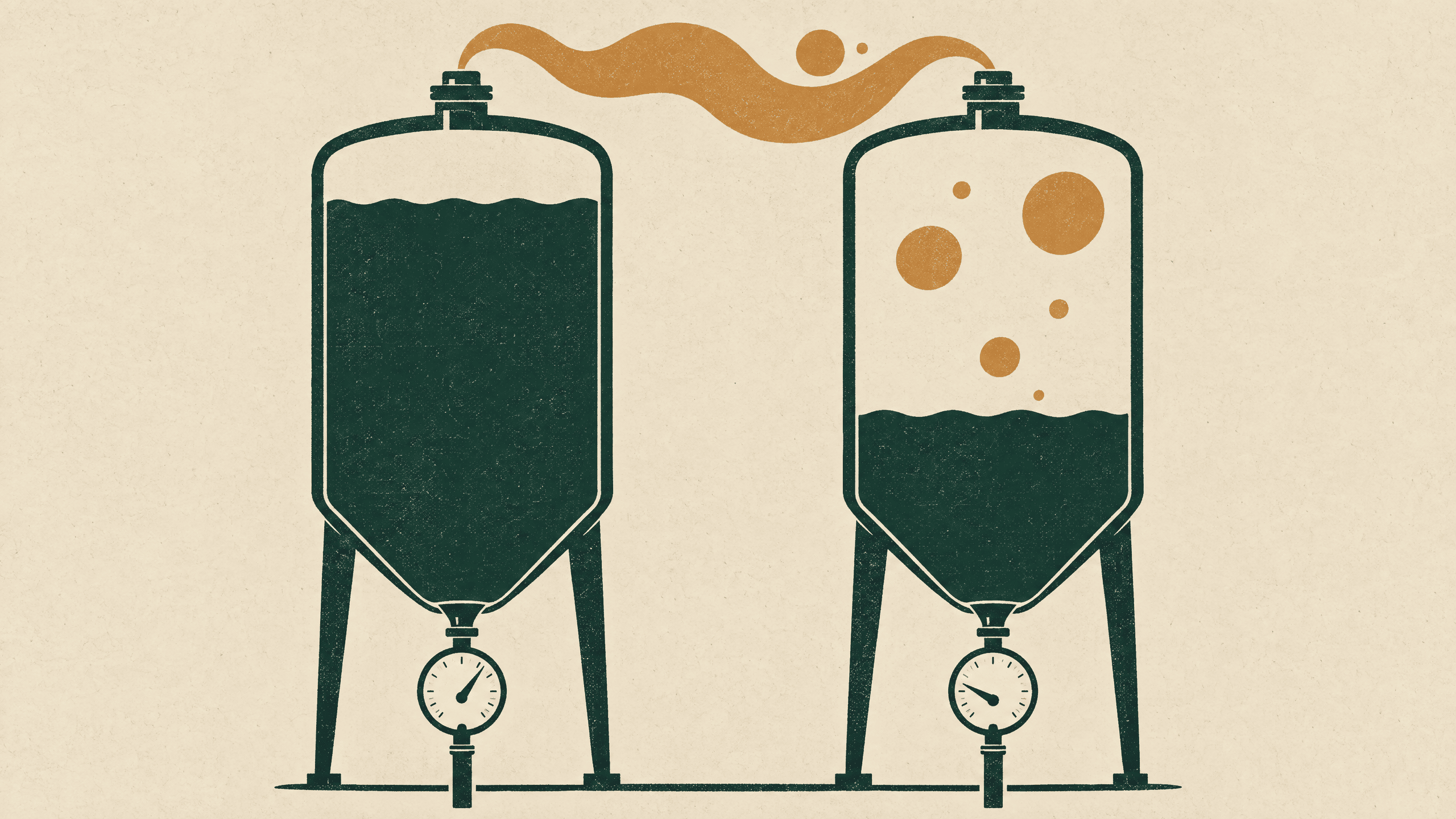
The first packages can look tidy, then the filler grows fussier later in the run. Foam changes, fill behaviour drifts, or a once-steady line starts asking for attention. It is tempting to treat that as a filler problem alone. Often, though, the tank is presenting the line with different conditions as its liquid level falls.
That does not mean every late-run issue is lost carbonation. It does mean the tank level belongs in the troubleshooting record, alongside product temperature, pressure at the point being measured, and a properly taken dissolved-CO₂ check.
Growing headspace needs replacement gas
As product leaves a closed tank, the space above it grows. If no gas replaces that lost volume, the same gas has more room to occupy. Gas pressure, volume, temperature and amount are linked; at a broadly steady temperature, expanding that headspace tends to lower its pressure unless gas is added.[1]
This matters because carbon dioxide moves toward an equilibrium between the headspace and the liquid. At equilibrium, the dissolved concentration of a gas is related to that gas’s partial pressure above the liquid.[2] A falling carbon-dioxide pressure therefore changes the condition that was holding the beverage in equilibrium.
Equilibrium is not a stopwatch, and a tank gauge is not a dissolved-CO₂ meter. Product composition, temperature, the way gas contacts the liquid, and time all matter. In a real packaging run, use a suitable calibrated measurement method and sampling procedure to verify the finished beverage rather than inferring its dissolved CO₂ from a controller display or a single pressure reading.
Temperature deserves the same care. Gases are generally less soluble as temperature rises, so a warmer product requires different conditions to hold the same equilibrium carbonation than a colder one.[2] That is a reason to record temperature, not a reason to assume that every colder batch reaches its target faster.
Headspace pressure is not outlet pressure
There is a second change hiding below the surface. At the outlet near the bottom of a tank, pressure includes the headspace pressure plus the hydrostatic contribution from the liquid above. Pressure in a static liquid rises with depth because of the weight of that liquid.[3]
As the tank empties, that liquid column becomes shorter. Its hydrostatic contribution falls. So even if the pressure in the headspace is held steady, the pressure at the outlet can still decline over the run. The difference may be more noticeable with a taller tank or a low outlet, but the principle is the same in every vessel: a fixed headspace pressure is not automatically a fixed outlet pressure.
That distinction helps make sense of a familiar pattern. Early and late packages can see different tank-side conditions even when the top pressure looks calm. Restrictions, elevation changes and the filler itself add their own effects downstream, so avoid treating one tank gauge as a complete picture of what the filler sees.
Diagnose the run before changing it
When packaging behaviour changes with tank level, compare the beginning and end of the same run before chasing settings. A short run record can turn a vague hunch into a useful next check:
- Record tank level or elapsed time, product temperature, and the pressure reading with its sensing location.
- Note whether the observed pressure is at the headspace, tank foot, or elsewhere in the path.
- Log filler behaviour and foam as symptoms, not proof of a particular carbonation or oxygen problem.
- Compare a representative, properly collected dissolved-CO₂ result with the run record.
- Check that gas supply, connections, relief protection, and the packaging setup follow the equipment manufacturer’s SOPs. Keep carbon-dioxide safety and ventilation controls in place.
This approach separates a falling headspace pressure from falling hydrostatic head, and both from causes such as temperature movement, a restriction, or filler setup. It also gives the next packaging run a clear comparison point.
Choose the sensing point on purpose
For a controlled replacement-gas workflow, PacWizz offers two packaging connections with an important difference. Its Arm setup connects at the CIP arm and does not compensate for hydrostatic head. Its Foot setup reads at the bottom of the tank; the controller uses that reading to decide when to add gas to the headspace. The manufacturer also states that PacWizz does not vent in packaging mode.[4] That makes the configuration a choice about the pressure point being managed, not a direct measurement of dissolved CO₂.
Whatever the setup, avoid changing several variables at once midway through a run. First establish whether headspace pressure, outlet pressure, product temperature, or the filler response is actually changing. Then make a documented adjustment through the approved operating procedure and check the resulting package with the same measurement method.
A tank does not become unpredictable simply because it is nearly empty. Its headspace and liquid column are simply different from where they were at the start. Keep those two changes visible in the run record, replace headspace gas when your process calls for it, and verify the package itself. That is the practical route to a steadier pour from first fill to last.